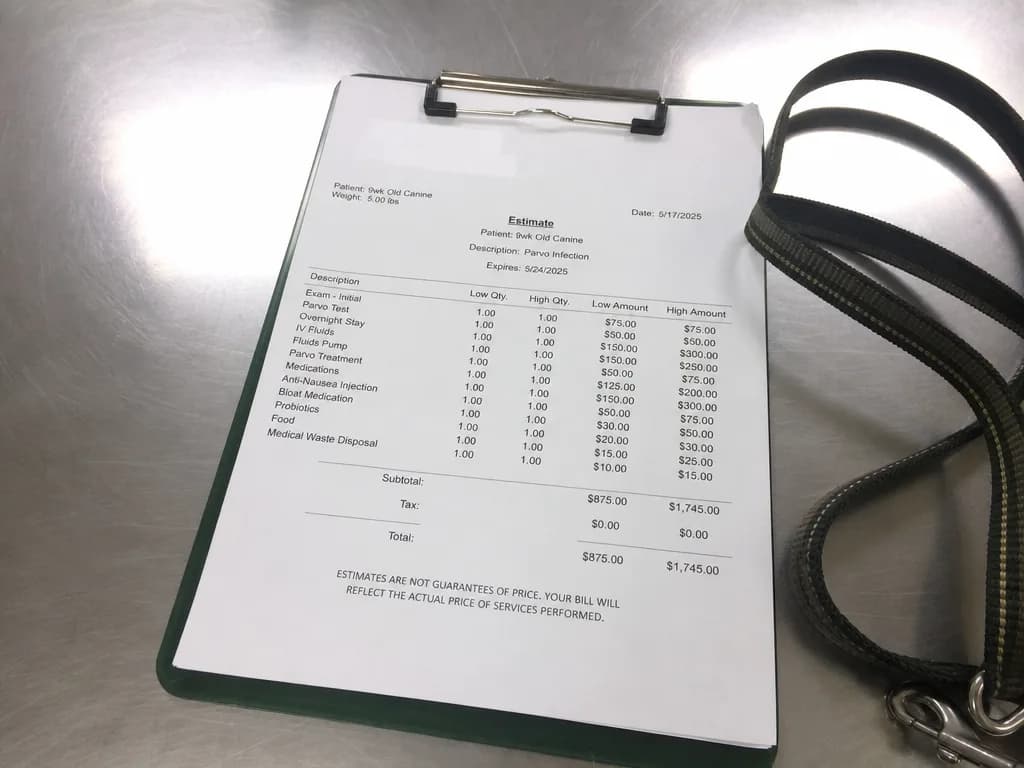
If you've ever searched this question in a panic, sitting in a vet waiting room or staring at an estimate you weren't prepared for, this post is for you. The cost of treating parvo is real, and in some cases it is genuinely staggering. But the number on that invoice is not random, and it is not arbitrary. It is a direct reflection of something that happened days before the dog ever walked through the clinic door. Understanding that changes everything about how you think about this disease.
Why Parvo Bills Range from $400 to $5,000
The single biggest factor determining what a parvo case costs is how many days of inpatient IV care the dog needs. And that number is almost entirely decided before the owner ever walks in.
Most people sitting in a waiting room processing a large estimate experience the cost as a feature of the clinic, the city, or bad luck. What it actually is, in most cases, is a direct readout of where the disease was when treatment started.
A dog that comes in on day one, still eating a little, mildly lethargic, first vomit, might need 48 hours of IV fluids, anti-nausea medication, and monitoring. The intestinal lining hasn't fully broken down yet. The white blood cell count is low but not collapsed. The body still has reserves. That is a $400 to $800 case at many clinics.
A dog that comes in on day three, not standing well, bloody diarrhea, severely dehydrated, WBC cratering, needs aggressive fluid resuscitation, sometimes plasma to maintain blood pressure, multiple medications, round-the-clock monitoring, and often 5 to 7 days of hospitalization before it is stable enough to go home. That is where the $3,000 to $5,000 numbers come from. Some critical cases at specialty emergency hospitals go higher.
The disease itself did not get more expensive. The dog just arrived later, and the body absorbed more damage before anyone started helping it fight back.
What the Estimate Actually Represents
When an owner sees a large treatment estimate and their brain goes to negotiation mode, wondering if the vet is padding it, whether another clinic would charge less, whether they can do half the treatment and hope for the best, those instincts are understandable and almost all of them lead to worse outcomes.
What the estimate represents is days. Each line item is roughly one day of the dog's life being supported externally while its gut lining regenerates. The gut lining of a healthy dog replaces itself every 3 to 5 days. Parvo strips it. Treatment is essentially buying time for that regeneration to happen while keeping the dog alive, hydrated, and protected from secondary bacterial infection through the open intestinal wall. You cannot shortcut the biology. You can only support it and wait.
What You're Actually Paying For: The Line Items
Here is what a parvo bill actually breaks into when you flip it over and read it.
Intake and Diagnostics
The SNAP parvo test runs $40 to $70. A CBC and chemistry panel adds $80 to $200. There is usually an exam or emergency triage fee of $50 to $150, higher at an after-hours emergency hospital. If the dog is severely dehydrated, additional bloodwork to check electrolytes and blood glucose may be added, especially in small breeds prone to hypoglycemia. This part of the bill rarely surprises people. It feels diagnostic, and diagnostic feels fair.
The Daily Hospitalization Core
This is where most of the money lives, and it repeats every single day the dog is admitted. The daily stack typically looks like this: a hospitalization and boarding fee of $50 to $150 per day covering the cage, the isolation space, and staff time; a one-time IV catheter placement of $40 to $80; IV fluids at $50 to $120 per day, sometimes more with aggressive rates, running around the clock; medications such as anti-nausea drugs like maropitant or ondansetron, antibiotics to guard the breached gut lining against sepsis, and sometimes a gastroprotectant, roughly $30 to $100 per day combined; and nursing care and monitoring including temperature checks, weight tracking, repeated assessments, and cage cleaning, often $40 to $100 per day.
Multiply that daily stack by 3 to 7 days and you have the bulk of any large parvo bill. Nothing exotic. Just relentless, repeating, around-the-clock support.
The Escalation Tier
When cases climb toward $5,000, it is usually because of one or more of the following. Plasma transfusion or colloids, used when a dog is losing protein through its destroyed gut lining and blood pressure won't hold, can run $200 to $500 or more per unit. Feeding tube placement for dogs that won't eat adds $100 to $300. Critical care upgrades at specialty hospitals carry their own daily premium.
The Charges That Feel Unfair Even Though They're Legitimate
The recurring daily hospitalization fee trips people up the most. Owners often mentally pay for the dog once and don't internalize that the cage and care fee hits again every midnight. Seeing "hospitalization $125" appear five times on one invoice feels like being charged repeatedly for the same thing. It isn't. It is five separate days of a living animal being kept alive. But emotionally it reads as duplication, and that is the line item that most often creates friction at the front desk.
The biohazard and isolation surcharge catches people off guard too. Parvo waste is genuinely hazardous. The protocols for decontaminating a parvo cage are intensive and require specific agents, because ordinary cleaning products do not kill the virus. Owners rarely expect a cleaning charge and it feels petty in the moment. It is not. It is the clinic protecting every other animal in the building from a virus that survives in the environment for up to a year.
The overnight and emergency premium feels like a penalty for the timing of an emergency the owner didn't choose. The cost is real overhead because overnight staffing is expensive, but it lands hard on someone already in crisis.
The single best question to ask at admission: ask for an itemized estimate and ask the vet to flag which line items are daily-recurring versus one-time. An owner who understands that the bill is mostly "days of life support multiplied out" reads it completely differently than one who thinks they are being charged repeatedly for the same treatment. That thirty-second conversation prevents nearly all of the anger that happens at discharge.
When You Cannot Afford Full Hospitalization
This is the conversation that does not always happen clearly enough, and it needs to.
Outpatient Treatment: The Most Underused Option
Instead of admitting the dog for round-the-clock IV care, the vet administers subcutaneous fluids, injectable anti-nausea medication and antibiotics, and either keeps the dog for daily rechecks or teaches the owner to give fluids at home. Published studies on outpatient protocols in owned dogs show survival rates in the 50 to 80 percent range depending on how sick the dog is at presentation. That is meaningfully lower than the 85 to 95 percent of full hospitalization, but it is dramatically better than nothing, and it can bring a $3,000 to $5,000 case down to several hundred dollars.
This is real medicine at a fraction of the cost, and it is the most underused option on the table. If cost is a barrier, ask directly: "What can we do on an outpatient basis?" A good vet will have an answer.
CareCredit and Payment Plans
CareCredit is a medical credit card widely accepted at vet clinics, often with a promotional interest-free window if the balance is paid inside it. For an owner who has the income to repay but not the lump sum on hand, this genuinely bridges the gap. The honest caveat is that it is credit with real interest if the promotional period lapses, and approval depends on credit history. It works for people who can repay over months. It is not a solution for someone with no path to repayment.
Charitable Assistance Funds
Organizations like RedRover Relief, the Brown Dog Foundation, and various breed-rescue emergency funds exist specifically to help with veterinary bills. Some local shelters and humane societies also have emergency assistance. These are real and worth contacting, but funds are limited and applications take time. Parvo moves in hours. Start the call immediately rather than after two days of deliberation.
Crowdfunding: The Most Overrated Option
This deserves a careful, honest answer because it is the one most likely to give false hope at the worst possible moment.
Crowdfunding does work for some people. But it is the least reliable option for a parvo emergency specifically, for reasons that matter. The timing problem is the killer. Parvo decisions happen in hours. Crowdfunding raises money over days. A fundraiser posted at 9 p.m. while a puppy is crashing does not produce a usable balance by the time the treatment decision has to be made at 11 p.m. Most platforms also hold funds before they become withdrawable, so even a successful campaign does not put cash in an owner's hands at the clinic counter that night.
Crowdfunding is worth attempting as a parallel effort, especially to recoup costs after putting treatment on CareCredit. It is not a primary plan for an acute emergency.
Ranked honestly by what actually saves dogs when money is the constraint: outpatient treatment first, CareCredit second, assistance funds and nonprofit clinics third, crowdfunding last as a supplement rather than a lifeline. The single most powerful sentence an owner can say in that exam room is: "I can't afford full hospitalization. What are all of my other options?" Everything good on this list starts with that question being asked out loud.
What About Pet Insurance?
Pet insurance for parvo is worth it, but only if the policy is bought before the puppy is at risk. That timing is the entire issue.
Parvo is a young-puppy disease. The highest-risk window runs from roughly 6 to 20 weeks of age, which is the same stretch when people are bringing a new puppy home and putting "look into pet insurance" on a someday list. Standard accident-and-illness policies do cover parvo treatment, typically reimbursing 70 to 90 percent of eligible costs after the deductible. On paper, parvo is the textbook case for why insurance helps.
The Gotchas Owners Find Out Too Late
Nearly every policy imposes a waiting period before illness coverage begins, commonly around 14 days from enrollment. If an owner brings home an 8-week-old puppy, buys insurance the same day, and the puppy shows parvo symptoms on day 10, the claim falls inside the waiting period and gets denied. Parvo's incubation window and the insurance waiting period overlap almost exactly with the puppy's highest-risk weeks.
Pre-existing condition exclusions are the second trap. If the puppy showed any symptom before the policy was active, even a vague note in the vet record about being "off," the insurer can classify parvo as pre-existing and deny the claim outright.
The reimbursement structure surprises people too. "Ninety percent covered" leads owners to mentally erase the bill, but they still pay the full amount up front and get reimbursed later. An owner in the waiting room needs the cash or credit to cover everything on the spot.
The Honest Bottom Line on Insurance
The most valuable move is buying the policy before the puppy comes home, so the waiting period clears before the dog enters peak parvo risk. For parvo specifically, there is a strong argument that the cheapest and most effective protection is not insurance at all. It is completing the vaccine series on schedule. The full series runs roughly $75 to $150 and prevents the disease with high reliability. Insurance pays out after a dog gets sick. Vaccination keeps the dog from getting sick in the first place. You can read more about how the disease works and spreads on our parvovirus page.
Where insurance earns its keep is everything else a dog's life will throw at it: the swallowed sock, the torn ACL, the cancer at age nine. The clearest framing: vaccinate to prevent parvo, and insure to survive the dozen unpredictable things vaccination cannot touch.
The Frame That Actually Changes Behavior
The thing worth walking away knowing is not "act early or you are a bad owner." It is that early is when you are strong.
In parvo, timing, cost, and outcome are not three separate things. They are the same line read at three different moments. The bill on day three is not bad luck. It is a readout of how long the dog waited before help started. The survival odds on day three are lower for the same reason. Timing sets cost and outcome simultaneously, and timing is the one variable an owner fully controls.
Early is when a vet has the most tools, the dog has the most fight, and the bill is the smallest. Waiting does not just risk a worse outcome. It actively spends down the leverage you start with. The dog is never more saveable, and never cheaper to save, than in the window when the owner is most tempted to wait and see.
This is also where tools like ParvoMaps fit without any guilt attached. An owner who sees a confirmed parvo case reported two ZIP codes over does not need to feel afraid. They just need that information to move their internal threshold from "let's see how tonight goes" to "we're going in this afternoon." That is the entire function. It turns a vague worry into a same-day decision at exactly the moment the decision is cheapest to make. You can check the live map or see outbreaks in your state for your area.
The practical rule an owner can actually hold onto: a young or unvaccinated dog showing lethargy and appetite loss for more than 12 hours gets a same-day vet call, not a wait-and-see night. Not because something terrible will definitely happen. Because that call, made early, is the cheapest and most powerful thing they will ever be able to do for that dog, and the power only exists inside that window. If you are still not sure what you are looking at, our guide on how to know if your dog has parvo walks through the early signs.
The owner who acts early and the owner who waits usually love their dog exactly the same. The difference between them was never love. It was information, arriving in time to be useful.